Remix Studio Handoff
Everything Aydan and Claude worked out between Nov 7 and Nov 12: what each stage of a Studio production is, rough screens for every stage, and the test runs that proved (or killed) each method. Look it over and refine. The stage decisions are made; only 7 questions about the Factory code are left for you, at the bottom.
Three things to look at, in this order
Stage UI sketches
16 rough wireframes, one per stage, plus the stage rail and the frame around every screen. The main thing we want your eye on.
2The stage table
Stages 0, R and 1 to 14: what goes in, what comes out, who approves, which model.
3Decisions, then 7 questions
What Aydan locked on Nov 12, and the 7 Factory questions only you can answer.
What we'd like back from you
- Mark up the sketches: wrong stage, missing control, wrong order.
- Answer the 7 Factory questions at the bottom. Push back on any decision that breaks something in the code.
They are called keyframes
decided Keyframes: one shot's layout drawn in the real look with the real cast, handed to H3 as the frame to open on ("start keyframe"). It is the word AI video tools use for exactly this picture, and the Factory code already uses it.
"Keyframe" now means only that. Storyboard drawings are storyboard frames. Character, place and prop images are sheets. Frames cut from a picked take to lock the final render are lock frames. Older docs that say "stills" or "storyboard / keyframe image" mean the same things under the old words.
Sheets vs storyboard frames vs keyframes
"What does this thing look like?"
One character, place or prop, alone, in the final look. Made once, locked, reused in every shot. One person per sheet, always.
"What happens and where is everything?"
Cheap, colourless, LOOSE: blank-faced figures, block props. Only framing, positions and poses. Never the real characters.
"What should this shot look like on screen?"
The storyboard layout redrawn in the real look with the real cast from the sheets. Fed to H3 as the reference to open on. Start only, never an end one.
Sheets are the cast and sets, the storyboard is the plan, keyframes are the plan dressed in the cast and sets. The storyboard does not feed the sheets: both feed the keyframes.
The stage table
"Standard" means every production has it. "Some" means only some video types.
| # | Stage | When | In | Out | Human approves | Tool or model |
|---|---|---|---|---|---|---|
| 0 | Brand pack | Once per brand | Brand idea, look, tone | Look line, locked brand sheets, voice cast, locked models, rules | The whole pack | gpt-image-2.6 flare (PS2 look), ElevenLabs casting |
| R | Reverse-engineer | Some (from a reference video) | A reference video | Breakdown, a preset (format, pacing, look), source clip saved for motion copy | The preset, after one test video proves it | Factory analysis worker |
| 1 | Idea and research | Some (narrated style, autopilot later) | Brand pack, trends, presets | 2 to 3 concept options | Picks one | Text model, research feeds |
| 2 | Brief | Standard | Chosen idea or a typed request | Concept, format, length, cast, places, props, sheets needed | The brief | Text model |
| 3 | Story arc | Some (story-led, narrated) | Brief | Hook, progression, payoff | The arc | Text model |
| 4 | Script | Some (narration or dialogue) | Brief, arc | Exact lines with speaker | The lines | Text model |
| 5 | Timing | Standard | Brief, script, preset | Shot list: length, beats, where lines land, frames per shot | The shot list | Text model, real audio lengths once voice exists |
| 6 | Voice | Some (any speech) | Script, voice cast, shot lengths | One audio file per shot, padded with silence to shot length; then a quick timing recheck | Each line by ear | ElevenLabs |
| 7 | Sheets | Standard (new ones only) | Brief's sheet list, look line | One locked sheet per new character, place, recurring prop | Each sheet | gpt-image-2.6 flare |
| 8 | Storyboard | Standard, skipped for copycat | Shot list | Loose S3 ink + grey frame(s) per shot | Each frame, with mark-up | gpt-image-2 low (cheapest usable) |
| 9 | Keyframes | Standard (first shot and every cut to a new angle), skipped for copycat | Approved storyboard frame, the shot's sheets, the previous pick's last frame | Start keyframe only, never an end one, real look, 768x1344. Continuing shots start from the previous pick's last frame | Each keyframe, with mark-up | gpt-image-2.6 flare, 768x1344 (worker change in a separate brief) |
| 10 | Video drafts | Standard | Sheets, keyframes, pinned audio, optional motion clip, prompt | 4 draft takes per shot at 480x864 | Prompt editable; motion-copy feed size | MiniMax H3, reference-to-video only |
| 11 | Review and pick | Standard | The 4 takes | One pick per shot with a reason, or a retake | The pick | Studio review screen |
| 12 | Final render | Standard | The pick, its seed, lock frames cut from it | One 768x1344 render per shot | Final matches pick | MiniMax H3, never an upscaler |
| 13 | Edit | Standard | Finals, narration, music, captions; split-screen crop set here on the real video | Finished video | Rough cut, then final cut | Edit script (ffmpeg) |
| 14 | Sign-off | Standard | Finished video | Files in B2 and the drive, run record | Named sign-off | Archive job |
| Video type | Uses | Skips |
|---|---|---|
| PS2 sketch (Back Nine) | 2, 4, 5, 6, 7, 8, 9, 10 to 14 | 1 and 3 optional |
| Narrated 2D flat (yours) | All of 1 to 14. Narration frozen first, sets every shot length | Nothing |
| Beat-led, no speech | 2, 5 (to the beat), 7, 8, 9, 10 to 14 | 3, 4, 6 |
| Copycat | R, 2, 5 (from source cuts), 7, 10 with motion copy, 11 to 14 | 1, 3, 8, 9 |
| A comment like | Goes back to |
|---|---|
| Wrong face, outfit, missing bag | Sheets (7) |
| He should be on the left, camera too wide | Storyboard (8), then Keyframes (9) |
| Layout right, look off | Keyframes (9) |
| Hand through the cup, cart has no driver | Prompt in Drafts (10) |
| Shot rushed, line cut off | Timing (5), Voice (6) if audio changes |
| The joke does not land | Script (4) |
| Caption wrong, music too loud | Edit (13) only |
Anything changed upstream marks the work below it out of date; the orchestrator says what must be redone and what it costs before it starts. Full detail per stage: stage definitions draft.
Stage UI sketches
Rough wireframes on purpose: dashed lines, grey boxes, hand-style font. They are something to argue over, not a design to build pixel for pixel. Each screen shows its inputs, its approval gate, the mark-up tools and the open questions pinned on it.
Screens: stage rail, the frame around every screen, then 0 Brand pack, R Reverse-engineer, 1 Idea, 2 Brief, 3 Story arc, 4 Script, 5 Timing, 6 Voice, 7 Sheets, 8 Storyboard, 9 Keyframes, 10 Video drafts, 11 Review and pick, 12 Final render, 13 Edit, 14 Sign-off.
These fill the gaps found in the earlier test-run map: it had no Brief, Sheets, Timing, Keyframes or Edit screen, a text-only storyboard, no mark-up, no motion-copy feed choice, no crop box, no orchestrator log and no way to show a skipped stage. Its Review screen (4 seeds side by side, pick plus reason) and Run screen (cards, spend against cap) were kept as they were.
Test runs, Nov 7 to Nov 12
Every video below has its label burned in. All drafts are 480x864, MiniMax H3 on rented L40S cards.
About 100 clips on 4 cards: the base rules
- Reference-to-video only. Start/end frame (i2v) clips were bad and errored at full size.
- Drafts at 480x864 to pick; every final rendered natively at 768x1344 with the same seed plus 2 lock frames from the pick. Locked finals came back almost identical to the picks.
- No upscaling: SeedVR2 7B and 3B and a paid upscaler all failed on small faces.
- One person per sheet (Mike and Priya bled together). Carry the last frame of a picked shot into the next shot for continuity.
Voice before video
Record the line in ElevenLabs first, approve it, pin it as the shot's soundtrack from frame 0. H3 animates the lips to it. Method B said the line once, on time, 4 of 4 seeds (checked with a transcriber). Passing audio as a loose reference failed 4 of 4. Two speakers in one shot works too; it takes a couple of draft runs.
Layout images as references
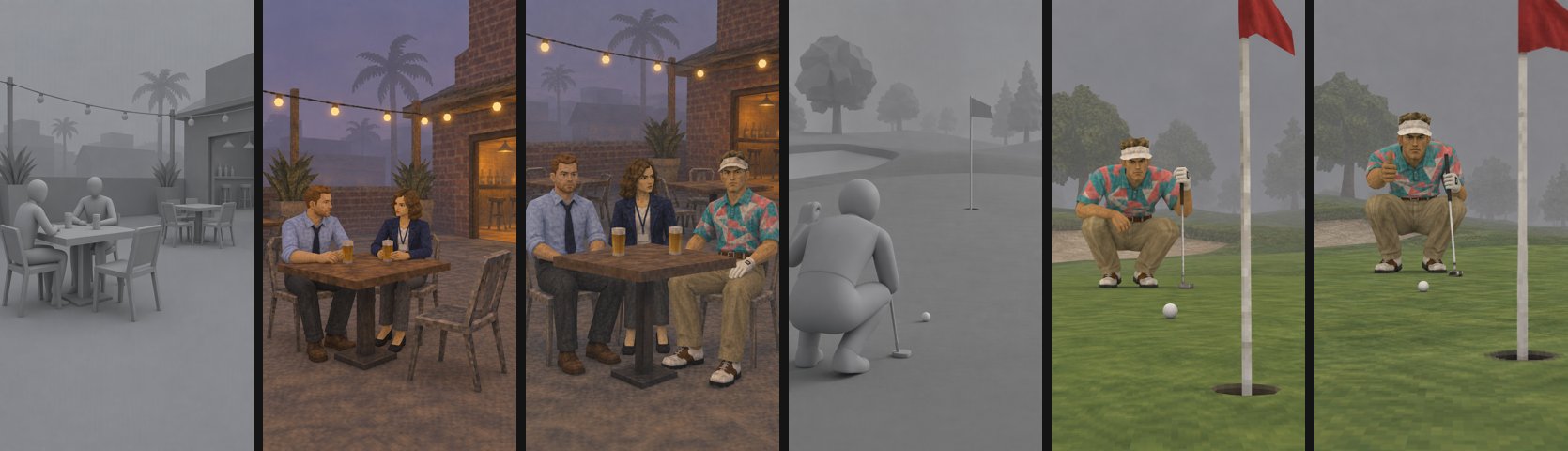
Start/end keyframes and a grey 3D blockout fed to H3 for G1A and G1X1. All 24 drafts are home. Keyframes are now standard anyway (decided Nov 12 after T8); T2 is still worth a look for the grey blockout arm.
Motion copy from real footage
Fix 2 (style picture) vs fix 4 (outline) on cuts 10 and 8b. The real clip can be fed small (480x864, about 23 min per 5 s clip) or big (768x1344, about 39 min). Same swing and framing; big keeps fine detail like dirt off the ball. Studio offers both, with the time warning, and the stage agent never picks silently. Open issue: the ball reads as the cup.
Turbo drafts
4-step about 88 s, 8-step about 132 s per 5 s clip. Aydan: "worse quality but similar video in general". Still untested: does a turbo pick lock to the same take at 768x1344? That decides whether turbo becomes the draft default.
Storyboard style: S3 ink + grey tone
Six styles on shots 1B and 2D. Picked S3: clean black ink, flat grey marker tones, no colour. Made on the Factory image worker, gpt-image-2 low, the cheapest usable. Never redo one for imperfection: success is the video lining up with the frame.
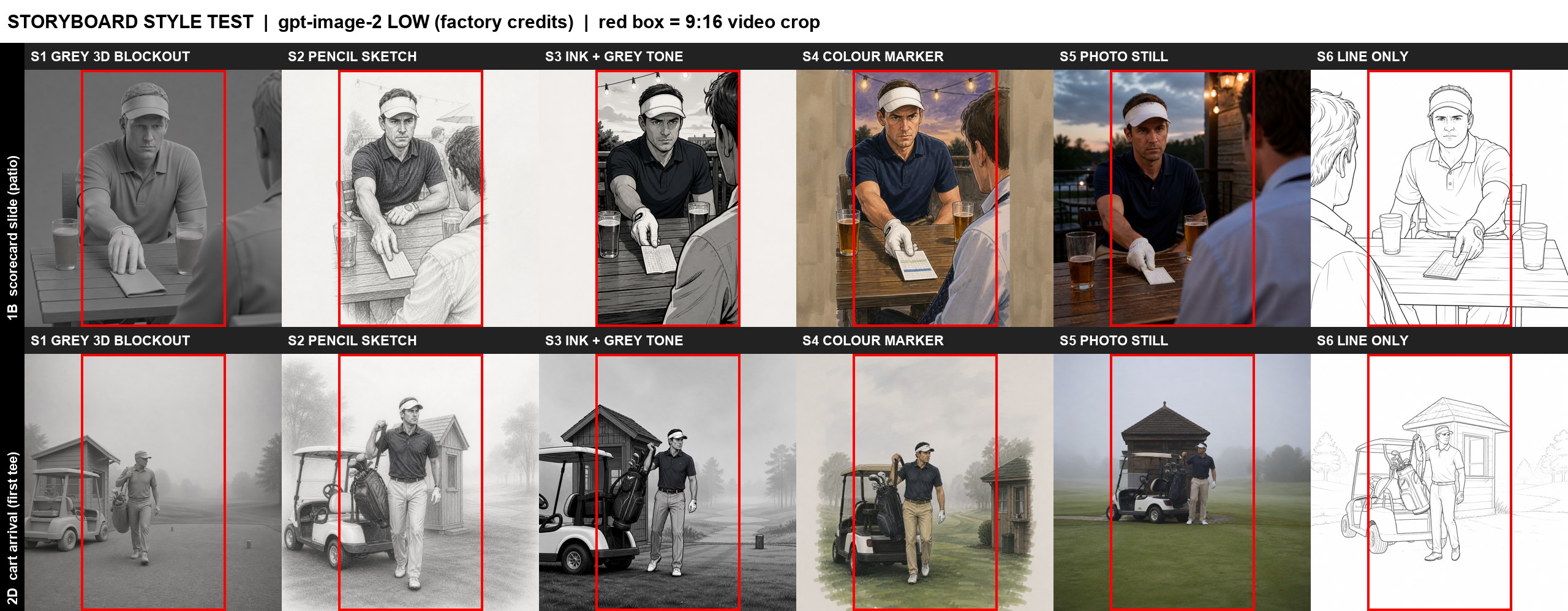
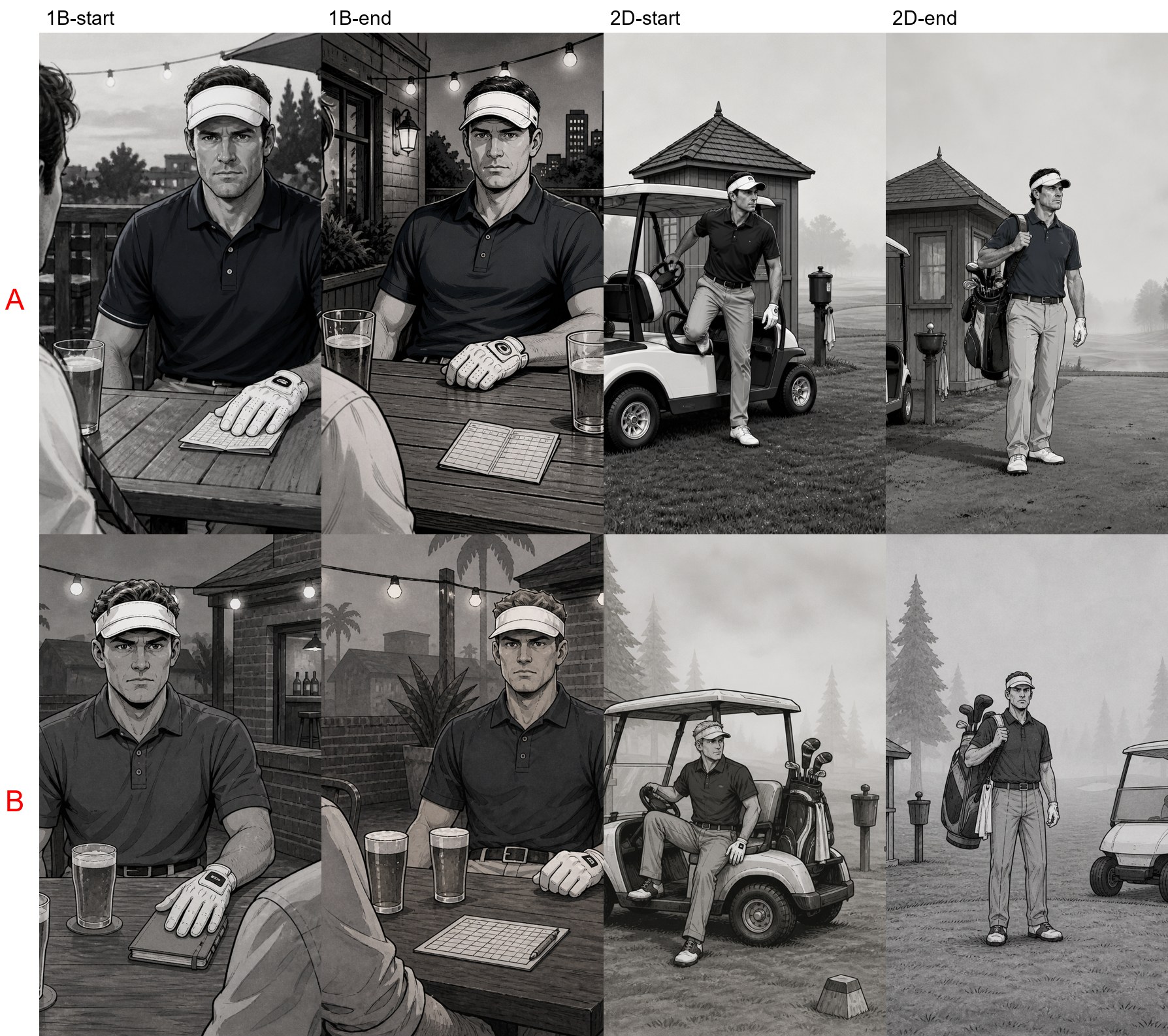
The full chain: sheets → storyboard → keyframes → H3
Step 1, storyboard A vs B. A drawn from text only, B with the locked sheets as references.
Step 2, the big lesson. Keyframes made from the detailed storyboard copied it exactly, mistakes included: palm trees, two beers, the wrong way to sit in the cart, Mike in the wrong place. So storyboards are now loose: generic blank-faced figures, block props, the layout written out in the prompt (who sits where, which side, how many of each prop). Identity and look come from the sheets at the keyframe step. Aydan: "the loose one is way better".
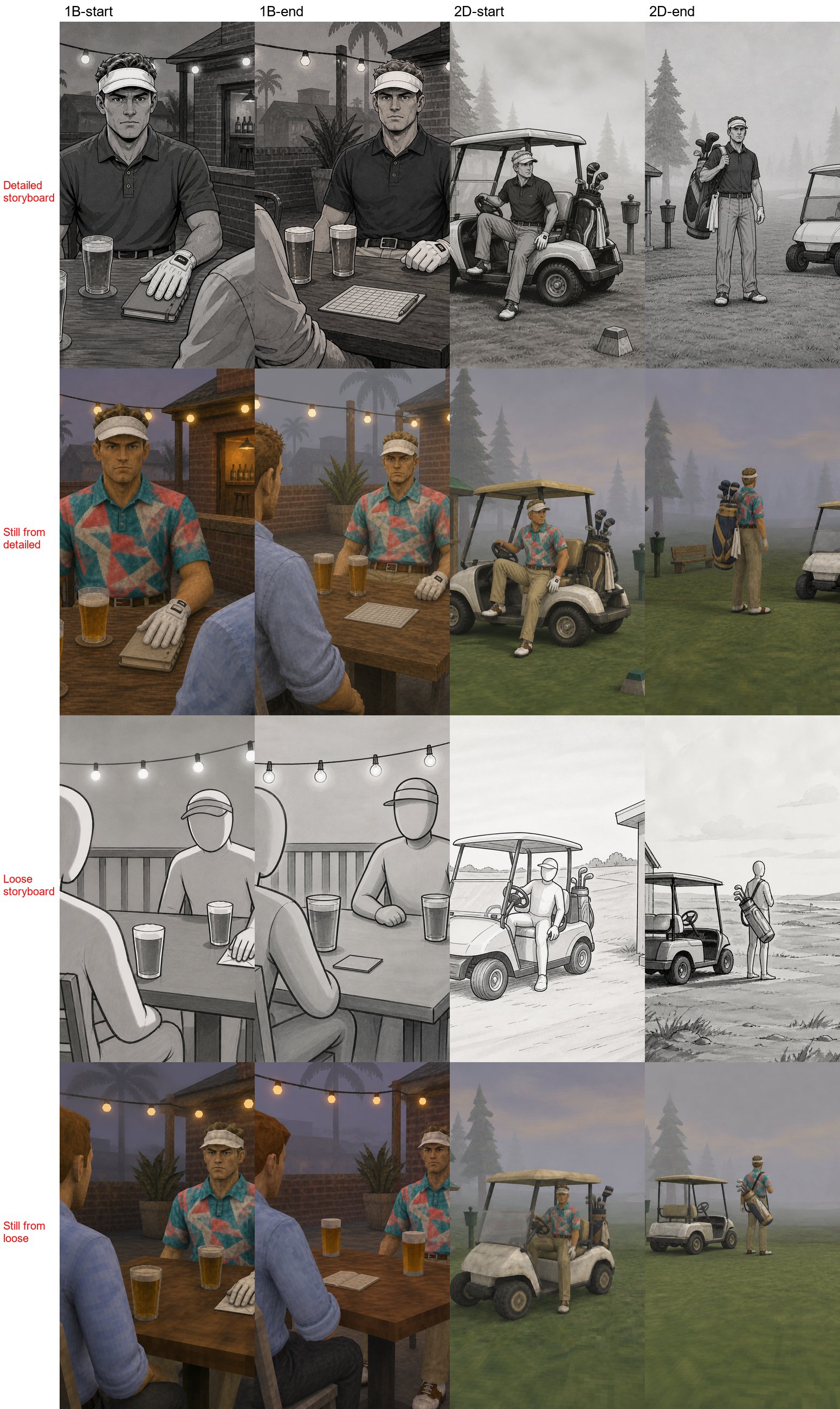
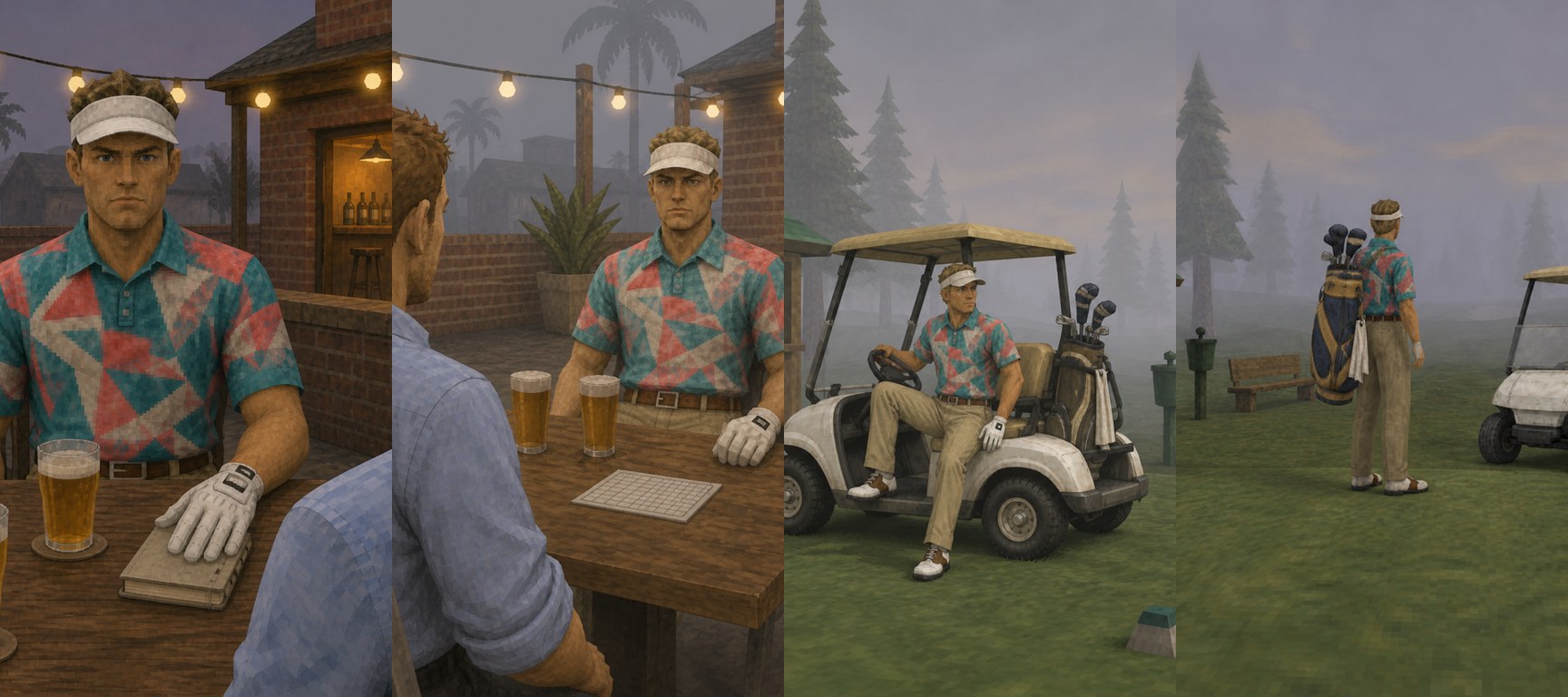
Also found: the palms and two beers are inside the locked patio sheet itself, so every patio shot inherits them. Fixing the sheet is Aydan's call.
locked Nov 12 Aydan's verdict: the loose storyboard as a reference (V2 loose) or a start keyframe made from the loose storyboard (V3 loose) are the best of every arm. Adding an end keyframe (V4) makes H3 do weird, cliche moves to force its way to the end frame, so use a start keyframe only. Still open: V2 loose vs V3 loose as the standard, one seed per arm so far, and no pinned voice was used in any T8 take.
Step 3, video arms (all 16 home Nov 12). V1 sheets only, V2 plus storyboard, V3 plus start keyframe, V4 plus start and end. Top row of each video is the detailed chain, bottom row the loose chain (bottom-left V1 is a second seed). 1B ran with no pinned voice.
T4, T6, T7
- T4 flat 2D (More to the Map): Caelan is testing his 2D path himself.
- T6 third lock frame: G2Cfix and G2D never checked frame by frame.
- T7 branded shirt: waiting on a shirt photo.
What is locked, and when
All of it, with reasons: H3 rules.
Where the Factory disagrees with the tests
Facts about the code as built, not decisions.
| Area | Factory today | Tested method |
|---|---|---|
| Stage words | One "Image" stage; Voice after Video; no sheets, storyboard, timing, takes or final render | The stage table above |
| Video mode | H3 image-to-video, one first frame | Reference-to-video, pinned audio, motion copy |
| Voice | Assembly replaces the shot's sound with voiceover | Voice baked into the clip so lips match |
| Final size | Assembly scales to 1080x1920 | 768x1344 native, no upscaling (question 4) |
| Image size | 1024x1024, low quality, hard-coded | Tall keyframes at higher quality (change requested separately) |
| Image model | "Flare" has no verified provider model ID | Needs confirming (question 1) |
What is settled
These were the open questions in the stage doc. Aydan answered them on Nov 12. Read them as rules for the stage design, not proposals.
Names
- decided The in-style frame for a shot is a keyframe. The word is never used for storyboard frames or sheets.
- decided "Storyboard" means the loose drawn frames. The Timing stage owns the shot list: each shot's number, length and what happens in it. Later stages read that list and never change it.
Order
- decided Brief, Script, Timing, Voice, then Sheets and Storyboard side by side, then Keyframes, Drafts, Pick, Final, Edit, Sign-off.
- decided Timing and Voice are two stages: Timing, then Voice, then a quick timing recheck against the real audio.
- decided Shot length is the longer of the spoken line plus a short pad, or the time the action needs. Timing writes down which one set it.
- decided Voice comes before the storyboard, because the real audio sets each shot's length. Voice is cheap, so it goes early.
Keyframes
- decided Keyframes are a standard stage. Start keyframe only, never an end one: an end frame makes H3 force weird moves to reach it (T8).
- decided The first shot gets a keyframe. A shot that continues the same camera starts from the last frame of the previous picked take, with no new keyframe. A cut to a new angle or place gets its own keyframe, made from the storyboard frame, the sheets and the previous pick's last frame so the look stays locked. untested last frame as the next start has not been run yet.
- decided A loose S3 storyboard frame can also go straight to video as a reference (T8 V2L). V2L vs a keyframe made from it (V3L) as the standard is still being judged.
- decided Keyframes are made at 768x1344 by the image worker. That change is a separate brief Aydan is sending you.
Storyboard
- decided One frame per shot by default. Timing can call for more on a busy shot.
- decided S3 loose ink style everywhere for now. Generic figures and block props, no outfits: detailed storyboards get copied exactly, mistakes included (T8).
Copycat
- decided A copycat skips idea, story arc, storyboard and keyframes. The real reference video fixes layout and motion; one style picture plus the sheets lock the look (as in T3). Script and Voice run only when the copy has speech.
- decided The human flags a copycat in the brief; the reverse-engineer agent can suggest it. A preset is saved when a human approves its one test video.
Approvals and mark-up
- decided When a frame is circled and commented, the orchestrator decides what kind of fix it needs and asks before any spend.
- decided Every gate is human for now. Either Aydan or you can approve.
- decided A prop gets its own sheet once it shows up in 2 or more shots.
Voice, crop, storage
- decided Voice uses ElevenLabs directly. No Sume.
- decided Two speakers in one shot is fine, no need to split them. Expect a couple of draft runs to get both mouths right (Aydan has done it).
- decided Turbo drafts are not the default until a turbo pick is shown to lock the same at full size.
- decided The split-screen crop box is set on the real picked video, in Pick or Edit. Timing only has drawings, so it can't place a crop.
- decided Raw media lives in B2, finished files on the drive, briefs and storyboards in the project backend.
- decided Older docs that describe rejected methods (H3 generating dialogue, end keyframes, detailed storyboards) are marked replaced.
- decided You test the 2D narrated path yourself.
Tests still owed
- Last frame of a picked take as the next shot's start.
- V2L vs V3L with more than one seed, and with a pinned voice (T8 was silent).
7 questions about the Factory code
Everything else is decided above. These depend on how the Factory is built, so they are yours.
- What is the exact provider model ID for "gpt-image-2.6 flare"?
- Do the new stage names replace the queue's stage list, or sit inside its "Image" stage as sub-steps?
- Does the video worker get reference-to-video with pinned audio and motion copy, or does Aydan's hand runner become the worker?
- Assembly scales to 1080x1920. Is that an acceptable delivery resize? (Upscaling inside generation is banned.)
- Edit stage: extend the assembly worker, or adopt the edit script as the worker?
- Locations and props: new library kinds, or project assets?
- Is this package plus the test runs the evidence D-003 asks for, and which stage screen gets built first?